Narrative Games in the Age of AI
What we learned building a murder mystery with Lemony Snicket: on authority, constraint, and using AI as one wire in the sculpture.
What we learned building a murder mystery with Lemony Snicket
For most of human history, there was a stark line between audience and story. The audience heard the story, read the book, and eventually watched the movie. The story happened while you observed.
Interactive storytelling changed that. There were choose-your-own-adventure books (remember those?), then RPG and narrative games. Now, AI is changing things again.
This week, The Atlantic released an interactive murder mystery co-developed by Redspring, written by Lemony Snicket and illustrated by Michael Kupperman. Players step into the role of detective in a closed park, talk to a cast of eccentric characters, and try to figure out who committed the murder. The characters are powered by AI, but the story architecture is still human.
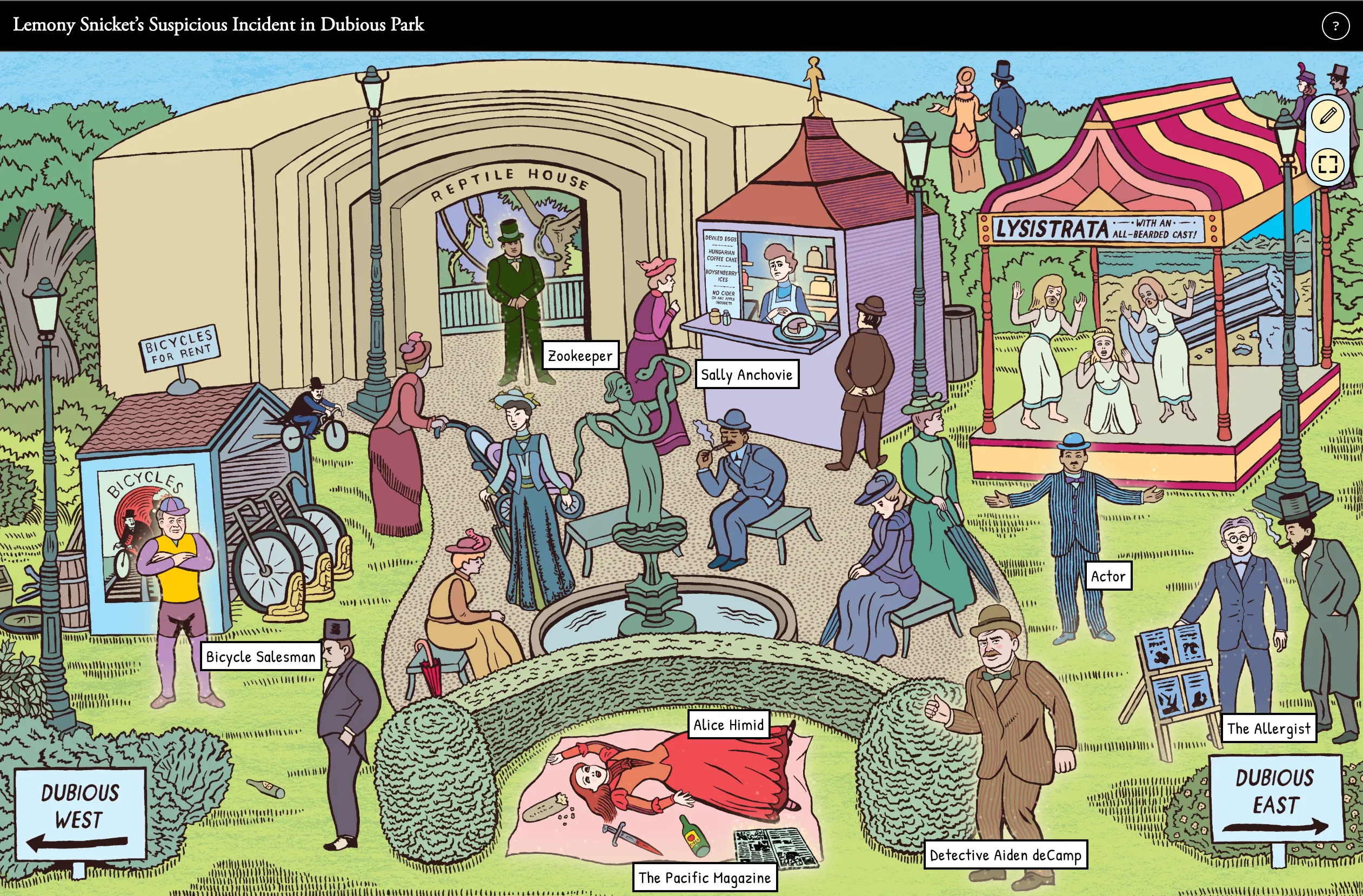
Dubious Park, illustrated by Michael Kupperman
We sat down with Caleb Madison, former director of games at The Atlantic and the person who originally conceived of the project, to talk about what we learned over the last year building a human-authored game with characters you can interrogate in real time.
The problem of authority
Caleb has been making games since he was fourteen, mostly crosswords. To him, the appeal is simple: games create a bounded arena with a final, true answer (something we don’t often find in the real world). A game designer leads a player towards a certain outcome, ideally in a dynamic and entertaining way.
We were all captivated by the idea of bringing AI into that world. Can we use this new medium as a way to tell stories that you can engage with, that feel surprising, and that pique your curiosity because they evolve?
That idea runs directly into a fundamental challenge of AI today: uncertainty.
In a traditional story, the author is the source of truth. If the novel says it was a dark and stormy night, the reader accepts it. But in an AI-mediated experience, where you discover the story through conversation, who is speaking with authority? The author? The system? The character? The model?
This became our central design problem. The original concept had psychologically layered suspects who could be caught in lies. It was an Agatha Christie-style cross-examination where players would triangulate the truth by finding contradictions. Caleb described why that didn’t work: “If this one thing is a lie, then how many other things are lies? It becomes a hall of mirrors.”
Lemony Snicket, it turned out, understood this intuitively. His creative instincts pushed the game away from forensic interrogation and toward something more expansive. We were soon building an oddball ensemble in a fully realized world, where the characters had distinct personas and the players were fully inhabiting the space.
Lemony helped us realize that the solution was to give the characters a strong enough identity that players trust them even when they surprise you.
Building the game
Early in the project, we developed a character builder that let an author train a character through dialogue, refining its persona until it feels consistent. It was a good idea, but it wasn’t quite right for this project.
Working with a writer like Lemony Snicket, who already had a rich and specific creative universe, the character builder felt stifling. Instead, the best approach was to give him room to define the characters in longhand, in his own voice, with his own instincts. Our job became translating those authored characters into personas that could hold up inside an interactive system.
That required a lot of testing. We put the game in front of as many people as we could, watched their conversations, and learned which paths worked and which led nowhere. Coordinating characters, world knowledge, player knowledge, and the investigatory path toward the solution were all refined through that process until the experience felt natural.
Players never see most of what makes the game work, and that’s part of what makes it a success. The fact that it feels simple is a big achievement. Underneath that simplicity is a system that we iterated on for months.
AI is just one wire in the sculpture
The question Caleb gets asked most about this project is some version of: isn’t AI just a way to cut corners? His answer, in this case, is definitely not.
“I see creative work and its relationship to tools or the medium of creativity as pretty consistent, whether it’s oil paint, film, or the computer. The amount of work that the creative person, or the people on the back end, put into the thing is directly proportional to how good it is. There’s no hack or way of getting around that.
We didn’t use AI as a shortcut for creativity here. Our desire, our curiosity, was to figure out how to integrate AI and LLMs thoughtfully into a larger storytelling experience.
This game would not be fun without Lemony’s story, which he put so much work and effort into; without Michael Kupperman’s beautiful illustrations; and without the hours and hours of collaborative work that all of us have done to fit this together in a way that feels satisfying.
My sense is that a game, in many ways, is like a big, complex digital sculpture. AI is like a little thing hanging on one of the wires in the sculpture. It’s not the base of the sculpture at all. It’s ornamental in a way that I hope lends itself to satisfaction and play.
This is an attempt to use AI as a medium in and of itself: as a material integrated into other creative materials, the visual arts and the storytelling arts, to be one part of the mosaic of the expression of a story and an experience.”
AI ≠ creativity
Towards the end of our conversation, Caleb voiced the most useful thing we took away from this project: making AI art means chiseling away at a vast space of possibility.
AI can generate almost anything. Creativity comes in when deciding what AI won’t do in a specific context. For the game, it was what persona a character holds to, what knowledge it has access to, and what the boundaries of the world are. We found that the more precisely we defined those constraints, the more the experience felt authored rather than generated.
The principle of constraining AI applies beyond games. Any time you build something with AI at its center, the quality of the output is determined by the choices you make about what the model is and isn’t allowed to do. Your choices as the system architect are the creative center of the output.
A peek into a bigger room
In the gaming world, we’re still in the early stages of AI integration. Caleb compared the current moment to the Lumière brothers projecting footage of a train arriving at a station: audiences ran because they didn’t yet understand the boundaries of the medium. (Probably an urban legend, but the comparison stands). Today, audiences and users are still figuring out where AI ends and where the human begins. That confusion is going to take time to resolve, and that’s why we’re continuing to experiment.
Building this game left us with a set of better questions. What does authorship mean when a reader can interrogate the characters? What does truth mean in a story where the player discovers it through conversation? What does constraint mean when the system could, in theory, say almost anything?
We don’t have tidy answers to any of those. But we know how to ask the questions more precisely than we did before. That feels like the right place to be when a medium is this young. We’ll be watching this space closely. As Caleb said, “I’m very fascinated by interactive storytelling, puzzles, games, storytelling proper, the classic storytelling of the 20th century and previous eras, and the intersection of all of them in the beautiful intermedia future that we are all barreling toward at breakneck speeds.”
Lemony Snicket’s Suspicious Incident in Dubious Park is live. Go solve a murder!